The Mu Continent & Origins Research
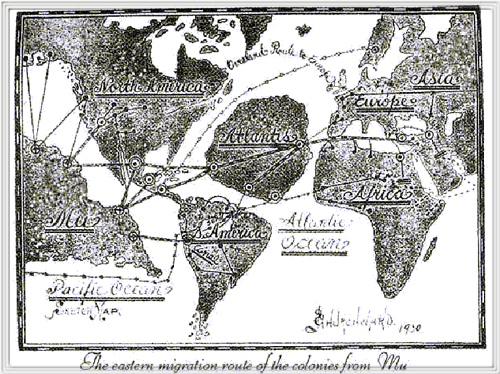
This card is in a different category from the others. Its subject is not a completed state project like a railway, a factory or an institution. It is a personal investigation Atatürk directed himself, into archaeology, comparative linguistics and ancient history.
Two separate things have to be kept apart. Mayatepek's assignment and the 14 reports he sent to Atatürk are real and historically documented; there is no doubt about that. What is disputed is the thesis of a Maya–Turkish linguistic and civilisational kinship put forward in the reports. Mainstream linguistics and archaeology today do not support this thesis.
The question "Where did we come from before Central Asia? In which lands did our ancestors live before the great civilisations?" led Atatürk into deep research in the 1930s.
Mayatepek's Mission
In 1932 the retired General Hasan Tahsin Mayatepek informed Atatürk that there were striking similarities between the Maya language and Turkish. Atatürk appointed Mayatepek Türkiye's chargé d'affaires in Mexico and gave him the task of studying Maya, Aztec and Inca cultures between 1935 and 1937.
Scope of the Research
- 14 reports. The reports prepared between 1932 and 1938 made up a three-volume study with hundreds of pages of notes, drawings and photographs.
- Language comparison. The reports claimed a similarity between the agglutinative structure of Nahuatl and Turkish.
- Mythological parallels. Tengri belief was compared with Quetzalcoatl, and Maya creation myths with Anatolian rituals.
- Architectural findings. Formal overlaps were sought between Maya ruins and Anatolian civilisations.
- Symbolic similarities. The reports pointed out that crescent-and-star, drum and shield motifs appear in both cultures.
These findings played a part in shaping the Sun Language Theory and the Turkish History Thesis. Though disputed in academic circles, they remain a concrete example of Atatürk's scientific curiosity and his capacity for interdisciplinary thinking.