Ideal Republic Village Project
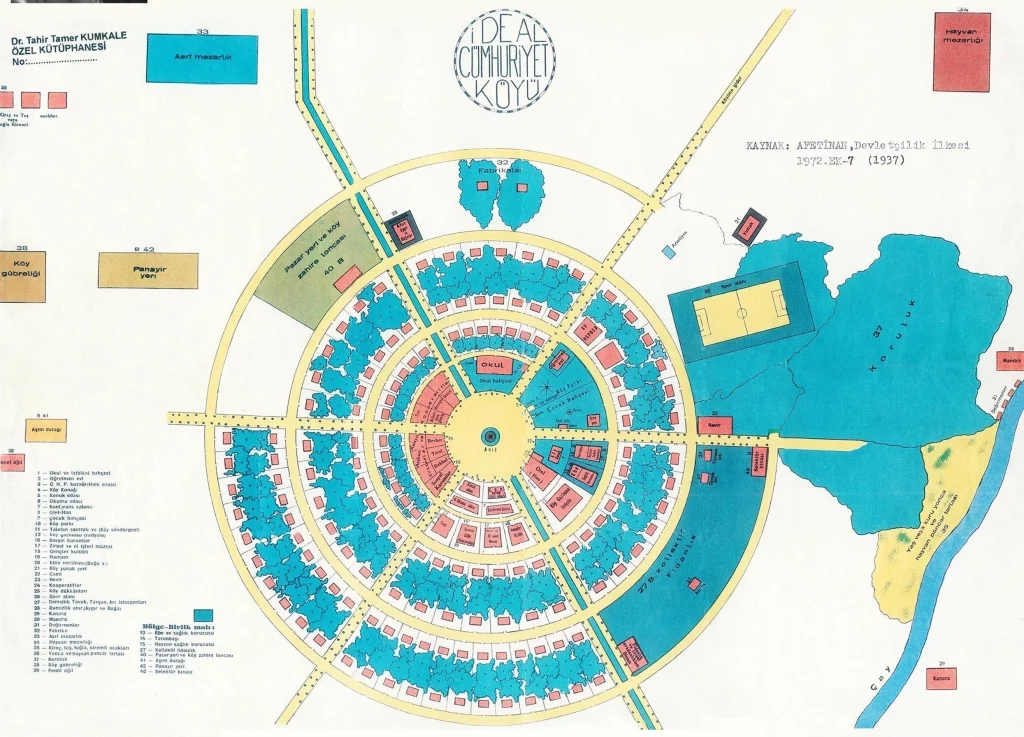
This project, drawn up in 1937, is a rural development model to which Atatürk personally contributed and in which he took a special interest. In the 1930s about 80% of the population lived in villages; the lack of infrastructure both lowered productivity and restricted access to health, education and culture. The "Ideal Republic Village" is the first systematic attempt at a planned rural development model that aimed to build up the village's own capacity directly rather than trying to change it from outside.
Features of the Project
- Planned settlement layout. Houses, public spaces and production facilities were designed as a functional whole; roads, the water network and access to energy were planned from the start.
- Cultural infrastructure. A village school, a library and an assembly square were mandatory components, securing village education and public life in physical space.
- Integration with production. Fields, barns, granaries and processing areas were planned next to the housing. The villager's daily working cycle was thereby shortened, reducing lost time and labour.
- Social welfare. A health post, a covered fountain, a village bath and a sports ground were written into the plan as "basic village equipment". This was the architectural expression of the Republican view that health and physical education are an integral part of rural life.
Because it represents an approach that "supports cultural and social structure while also increasing production and welfare", the model is a distinctive example in the history of urbanisation and rural development. The Village Institutes, founded two years after Atatürk's death (1940), were the practical continuation of this philosophy.
"The peasant is the master of the nation."
— Mustafa Kemal Atatürk, opening address to the Grand National Assembly, 1 March 1922