Aviation & Defense Industry
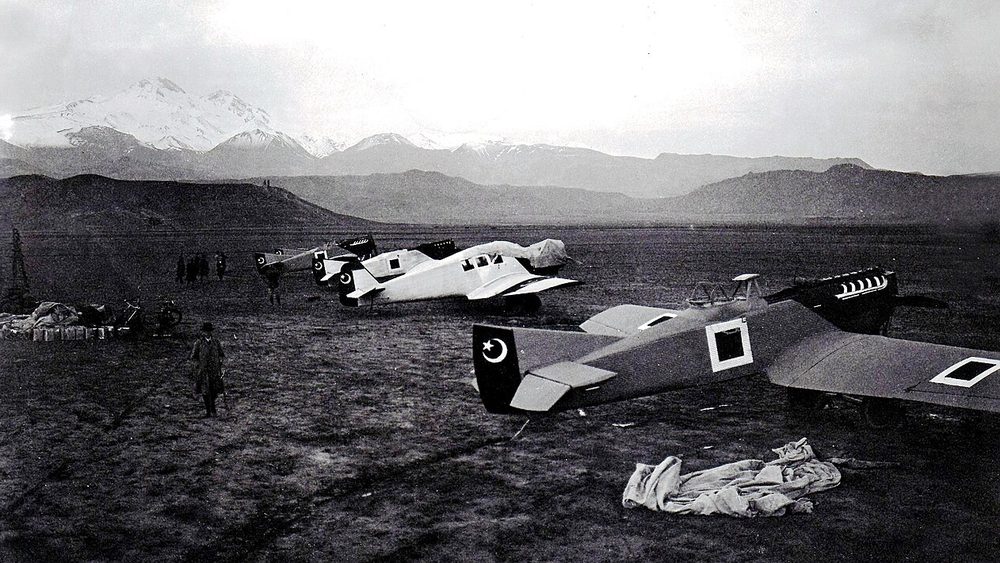
In the Republic's first years aviation was seen as a strategic field for both defence and industrialisation, and that view was backed by concrete factory investments.
"Turkish child, just as in every other field, you will soon fill the place awaiting you in the sky at the highest level, as in aviation."
— Mustafa Kemal Atatürk, at the opening of TürkkuşuTOMTAŞ: The Kayseri Aircraft Factory
Türkiye's first aircraft-manufacturing venture began with the Turkish–Junkers talks completed in the summer of 1925. An agreement signed on 15 August 1926 created the Tayyare ve Motor Türk Anonim Şirketi (TOMTAŞ), an equal partnership with capital of about 3.5 million TL (7 million marks); the plan also included a maintenance and repair facility at Eskişehir. The factory in Kayseri opened with an official ceremony on 6 October 1926.
- 1926–1927. The factory built 30 A-20 L and 3 F-13 aircraft. Some of the Turkish staff were also sent in groups to Junkers' plants in Germany for training.
- 1928. Junkers' financial difficulties, its failure to meet its obligations, the wage gap between Turkish and German staff and political interference brought the partnership to an end on 3 May 1928. Junkers transferred its shares to the Turkish Aeronautical Society (Türk Tayyare Cemiyeti) for 520,000 TL.
- 1930s. The factory was reorganised under the Air Directorate and kept producing aircraft and gliders under Curtiss (Hawk-II, Fledgling), Gotha, PZL and Miles (Magister) licences. Between 1926 and 1942 roughly 200 aircraft and gliders were built in total.
The point was not merely to build a factory: the real aim was to create a domestic pool of technical personnel and engineering capacity. The Ministry of National Defence traces the origin of today's 2nd Air Maintenance Factory Directorate in Kayseri to TOMTAŞ in 1926.
Other Facilities
- Turkish Aeronautical Association. It was founded in 1925 as the Turkish Aeronautical Society (Türk Tayyare Cemiyeti) and took its present name in 1935. It served as the umbrella organisation running donation and training campaigns for aircraft production.
- Nuri Demirağ Aircraft Factory (1936). The domestic entrepreneur Nuri Demirağ founded a private aircraft factory in Beşiktaş, Istanbul. Prototypes of the Nu.D.36 trainer and the Nu.D.38 passenger aircraft were built there.
- Kırıkkale Munitions Factory. Its foundation was laid in 1925 and it entered service in 1928–29. The first major plant of the defence industry, it forms the core of today's Mechanical and Chemical Industry Corporation (MKE); five of MKE's eight main factories are still in Kırıkkale.
The Treaty of Versailles had barred Germany from building up an aviation industry, so in the early Republican period Türkiye also became a strategic production partner for Germany.