Industrial Drive
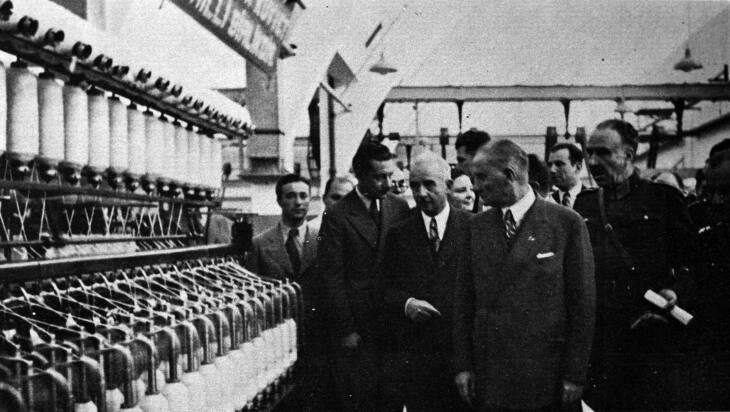
Starting with a limited industrial base, the Republic built a comprehensive system of production and industry within fifteen years. The main facilities inherited from the Ottomans were the Hereke Silk Weaving, Feshane Wool Yarn, Bakırköy Cloth and Beykoz Leather factories.
Between 1923 and 1938 the Republic added 46 further factories and industrial facilities. How this number is counted varies by source: sometimes it covers only plants that entered service, sometimes it also includes those whose foundations were laid but fell outside the period (for example the İzmir Chlorine and Sivas Cement factories, begun in 1938). So not all 46 facilities were producing at full capacity in the same year.
The 1929 Crisis: A Test of Economic Engineering
The Great Depression that broke out in 1929 crushed agricultural prices and dragged much of the world into contraction. Türkiye answered not with a free-market retrenchment but with planned statism; the First Five-Year Industrial Plan (1933) was the concrete product of that response. The result ran against the era's broader trend: according to secondary sources, industry's share of national income rose from roughly 10% in 1929 to roughly 18% in 1939. Türkiye, alongside the USSR, is often cited as one of the few economies that kept growing while most capitalist economies were contracting.
"When we speak of full independence, we naturally mean full independence and freedom in every respect — political, financial, economic, judicial, military, cultural. Being deprived of independence in any one of these is equivalent to the nation and country being deprived of the whole of its independence, in the true sense of the word."
— Mustafa Kemal Atatürk, Söylev ve Demeçler (Speeches and Statements)Major Facilities Established
- Sümerbank (11 July 1933). The bank was the executing body of the First Five-Year Industrial Plan. It was founded with 20 million TL of capital (raised to 100 million TL by 1939) and tasked with founding, financing and operating state factories. Plants such as Kayseri, Ereğli, Nazilli, Gemlik Artificial Silk and Bursa Merinos were built under its umbrella. Starting with five enterprises, Sümerbank reached 59 by 1945.
- Sümerbank Kayseri Textile Factory. The foundation was laid on 20 May 1934 and the factory opened on 16 September 1935. Designed in the Soviet Union and built with an 8.5-million-lira Soviet loan, it was the Republic's first large-scale modern textile mill built by the state.
- ETİBANK (1935). Created to operate the deposits MTA had discovered using modern methods, the state bank ran many enterprises, chiefly the Güleman chromite, Ergani copper and Zonguldak coal mines. It also built and operated regional electric plants.
- Karabük Iron & Steel Factory. Its foundation was laid on 3 April 1937, and it was Türkiye's first great step in heavy industry. It was contracted to the British firm Brassert under a £2.5 million British credit agreement signed on 10 November 1936. The first blast furnace was lit on 9 September 1939 and the first Turkish pig iron was tapped on 10 September 1939.
- Sugar factories. The Uşak, Alpullu, Eskişehir and Turhal sugar factories were transferred to Türkiye Şeker Fabrikaları A.Ş., founded on 6 July 1935, bringing them under a single roof.
- Paşabahçe, Nazilli, Bursa Merinos and Gemlik. These four were among the First Five-Year Plan's major investments. Paşabahçe belonged to İş Bankası, not Sümerbank; its foundation was laid on 14 August 1934, first production came on 4 July 1935 and it ended dependence on imported bottles and glass. Nazilli's foundation was laid in 1935, production began on 9 October 1937, and it was equipped largely with Soviet credit and machinery. Bursa Merinos and Gemlik Artificial Silk were both founded on 28 November 1935; Atatürk opened them himself in February 1938 (1–2 February).
Full Chronology (1923–1938)
- Ankara Cartridge Factory (1924). Türkiye's first domestic ammunition factory, it formed the basis of an independent defence industry.
- Gölcük Naval Shipyard (1926). Established on the Gulf of İzmit for the repair of the damaged battlecruiser Yavuz, the yard became the first major facility of the Republic's naval industry.
- Şakir Zümre Factory (1925). This plant, producing various industrial goods, was one of the private industrial ventures of the early Republic.
- Eskişehir Air Repair Depot (1925). It was the Turkish Air Force's first maintenance and repair centre and laid the foundation of today's 1st Air Supply and Maintenance Center.
- Alpullu Sugar Factory (1926). Built by İstanbul ve Trakya Şeker Fabrikaları T.A.Ş., the factory opened on 26 November 1926 and produced the Republic's first sugar.
- Uşak Sugar Factory (1926). The factory of Uşak Terakki Ziraat T.A.Ş., a company of local entrepreneurs, opened on 17 December 1926 after its foundation was laid in 1925; it ran at a loss because of its location and was transferred to Sümerbank on 11 July 1933.
- Kayseri Aircraft Factory (1926). TOMTAŞ, set up as a Turkish–Junkers partnership, was the first domestic aircraft-production venture.
- Kırıkkale Munitions Factory. Its foundation was laid in 1925 and it opened in 1928–29; the plant that forms the core of today's MKE produced rifles, cannon and ammunition.
- Bünyan Weaving Factory (1927). A wool-weaving plant set up in Bünyan, Kayseri.
- Eskişehir Tile Factory (1927). A state plant established to produce building materials.
- Kırıkkale Power Plant and Steel Factory. Sources date the founding of this integrated facility, which supplied energy and steel raw material to industrial plants, anywhere between 1926 and 1932; its capacity was expanded in 1931 to meet growing industrial demand.
- Ankara Cement Factory (1928). The first cement-production centre fed the Republic's construction drive.
- Ankara Gasworks (1929). The plant that built Ankara's urban energy infrastructure.
- Istanbul Automobile (Ford) Assembly Plant (1929). Ford obtained the right to set up an assembly plant from the government in February 1929; established in old warehouses on the Tophane quay, it was Türkiye's first car-assembly line and assembled cars until 1934.
- Kayaş Percussion-Cap Factory (1930). It produced caps and explosive components for the defence industry.
- Nuri Killigil plants (1930). The private entrepreneur Nuri Killigil set up a defence-industry plant producing pistols, mortars and ammunition.
- Eskişehir Sugar Factory (1933). It strengthened Central Anatolia's sugar-production capacity.
- Turhal Sugar Factory (1934). A sugar factory integrated with the beet growing of the Black Sea region.
- Ereğli Textile Factory. Its foundation was laid on 20 October 1934 and it opened on 4 April 1937; a cotton-weaving plant founded under Sümerbank.
- Bakırköy Textile Factory (1934). The yarn and cloth factory inherited from the Ottomans was modernised in the Republican era.
- Bursa Dairy Factory (1934). It is cited as Türkiye's first modern milk-processing and pasteurisation plant.
- Zonguldak Anthracite Factory (ground-breaking, 1934). It laid the foundation of coal-processing and cleaning infrastructure.
- Zonguldak Coal Washery (1934). It processed Ereğli-basin coal up to industrial quality.
- Keçiborlu Sulphur Factory (1934). It processed the sulphur deposits of Keçiborlu in Isparta, supplying raw material to the chemical industry; a new unit was added in 1935 as agricultural and chemical demand grew.
- Isparta Rose Oil Factory (1934). An export-oriented plant that raised Türkiye's share of world rose-oil production.
- Grain silos (1934). Silos built in Ankara, Konya, Eskişehir and Sivas allowed agricultural produce to be stored safely.
- İzmit Paper & Cardboard Factory. Its foundation was laid in 1934 and the first paper was produced on 18 April 1936; as Türkiye's first modern paper plant it was critical for press and education.
- Paşabahçe Glass Factory. Its foundation was laid on 14 August 1934; first production came on 4 July 1935 and the official opening on 29 November 1935. It ended Türkiye's import dependence for bottles and glassware, and by 1936 could meet the country's entire demand.
- Nazilli Cotton Print Factory. Its foundation was laid in 1935 and production began on 9 October 1937. Equipped largely with Soviet credit and machinery, this Sümerbank plant processed Aegean cotton, printing and dyeing cotton cloth.
- Bursa Merinos Wool Factory. Its foundation was laid on 28 November 1935; Atatürk opened this producer of high-quality woollen fabric on 2 February 1938.
- Gemlik Artificial Silk Factory. Its foundation was laid on 28 November 1935. Atatürk opened Türkiye's first artificial silk (viscose) plant on 1 February 1938.
- Ankara Çubuk-1 Dam (1936). The Republic's first dam: construction began in May 1930 and finished in April 1936, and it was opened with a ceremony on 3 November 1936. It supplied Ankara's drinking water until 1994 and was also used for irrigation and flood control.
- Zonguldak Hard-Coal Factory (1936). A processing plant built to raise output in the Black Sea coalfield.
- Powder, rifle and cannon factories (1936). Defence-industry capacity was expanded within MKE.
- Nuri Demirağ Aircraft Factory (1936). Founded by the domestic entrepreneur Nuri Demirağ, it was the second major aircraft-production venture.
- Malatya Cigarette Factory (1936). It brought tobacco processing and cigarette production to eastern Anatolia.
- Bitlis Cigarette Factory (1936). A regional factory supporting tobacco growers of eastern Anatolia.
- Malatya Textile Factory. Sources give its date anywhere between 1936 and 1939; built in the second half of the 1930s, this Sümerbank plant spread textile production across eastern Anatolia.
- Karabük Iron & Steel Factory (foundation 1937, production 1939). Established with British technical assistance, it was Türkiye's first great step in heavy industry. The first blast furnace was lit on 9 September 1939; production began after Atatürk's death.
- Divriği Iron Mines (1938). The mining operation supplying iron ore to Karabük was a link in the integrated steel chain.
- İzmir Chlorine Factory (1938). It produced chlorine and soda for the chemical industry and supplied raw material to agriculture and textiles.
- Sivas Cement Factory (1938). It met Central Anatolia's need for building materials locally.
- Sivas Locomotive Repair Works (1939). It brought locomotive and wagon maintenance capacity to Central Anatolia. Expropriation began in 1936 and it opened in 1939; an Atatürk-era project, it was completed after his death.
Some years in this list are foundation dates, some first-production dates and some official opening dates; since sources can differ by a year, the relevant dates are given separately wherever possible. Output growth figures for coal, chromium and sugar are quoted in secondary sources with differing base years, so no single multiplier or percentage is offered here; see the Mining and Agriculture cards for detail. Not every item in the chronology has been checked individually against primary sources; if you spot an error, please use the correction link at the bottom of the page.