1923 – 1938 · Institutions
Institutional Architecture
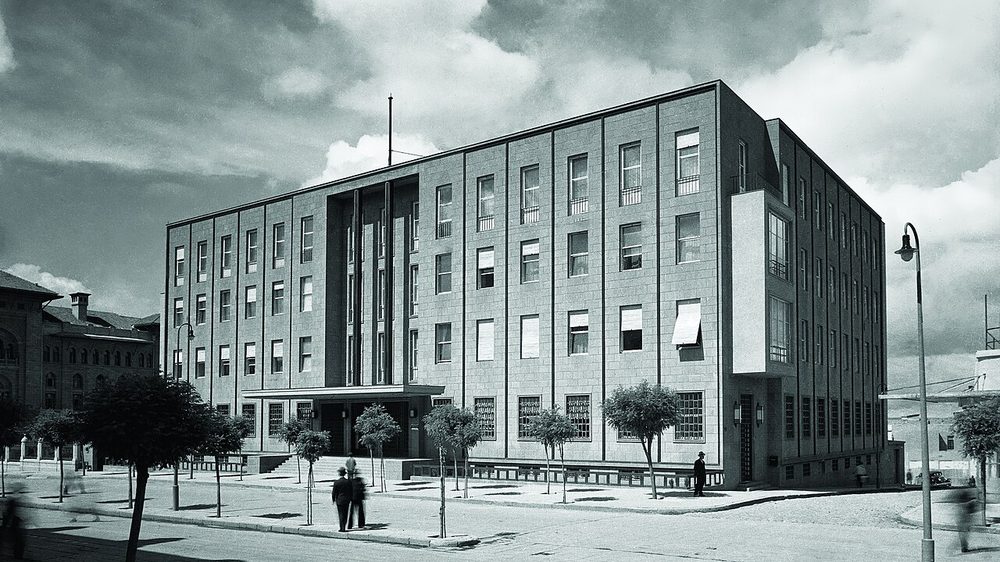
In just fifteen years the Republic built both the production infrastructure and the institutional framework to manage it. This simultaneous construction is one of the most distinctive features of the Atatürk era.
Institutions Founded
- Türkiye İş Bankası (26 August 1924). Founded on Atatürk's directive and in line with the decisions of the İzmir Economic Congress, it was the Republic's first national bank. The first branch opened in Ankara on 9 September 1924 and its first general manager was Celal Bayar.
- Industry and Mining Bank (19 April 1925). Created by Law No. 633, it was the first development bank, designed to lend to private industry and mining and to operate state factories temporarily. It failed to reach its goals and was liquidated in 1932.
- Real Estate and Orphans' Bank (3 June 1926). It was founded with 20 million TL of capital to provide construction credit and protect orphans' rights. Its first branch opened in Ankara on 13 July 1926.
- Central Bank of the Republic of Türkiye. Established as a joint-stock company with private-law legal personality under Law No. 1715 (adopted 11 June 1930), it began operating on 3 October 1931.
- Bank of Provinces (11 June 1933). Created by Law No. 2301 under the name "Municipalities Bank", it provided financing, advisory services and infrastructure support to provincial administrations and municipalities. It took its present name in 1944.
- THY (Turkish Airlines, 20 May 1933). Law No. 2186 founded it as the "State Airlines Administration" under the Ministry of National Defence. Its first fleet was five aircraft — two King Birds, two Junkers F-13s and one ATH-9 (Tupolev ANT-9) — and early services ran Istanbul–Eskişehir–Ankara. It took the name Türk Hava Yolları under Law No. 6623 in 1953 and became a joint-stock company in 1956. It was designed as an instrument of both civil transport and political integration.
- PTT. It was reorganised under one roof by the Postal Law No. 376 (1923) and the Telegraph and Telephone Law No. 406 (1924). Post offices became the state's widest network of contact in the countryside, and through tools such as savings accounts and stamps they also served as a gateway to financial access (see the Communications card).
- MTA (June 1935). Founded by Law No. 2804, the institute's task was to explore and map Anatolia's underground resources, which had not been systematically studied in Ottoman times. From its founding to 1939, 1,319 sites were surveyed; the operation of the deposits found was handed to Etibank. It works today as the MTA General Directorate (see the Mining card).
- State farms. Karacabey Stud Farm (1926), Ceylanpınar (1937 law) and similar farms were created for seed improvement, livestock breeding and model enterprises. TİGEM, founded in 1984, runs a portion of them today (see the Agriculture card).
- Denizbank (1937). This state bank, created by Law No. 3295, aimed to bring Denizyolları, port operations and AKAY under one roof. After operating for about a year and a half, it was abolished in 1939 and converted into the State Maritime Lines Administration (see the Maritime card).
- Nationalisation of the Tobacco Régie (1925). The tobacco monopoly, one of the heaviest legacies of the Ottoman era and run under the supervision of foreign creditors, was transferred to the Turkish state for 4 million lira. This step was the first concrete application of the İzmir Economic Congress's goal of "national economic sovereignty".
- Land Registry and Cadastre General Directorate. The Ottoman property system of unrelated documents (tapu-i hümayun, temessük, hüccet) invited overlapping claims on the same parcel. A Land Registry General Directorate was founded in 1924; Cadastre Law No. 658 of 1925 added a cadastral unit, and from May 1925 ownership-cadastre surveys began in Ankara, Istanbul, İzmir, Bursa and Konya. The legal framework of cadastre in the modern sense came with the December 1934 Cadastre and Land Registry Survey Law (No. 2613) and the Land Registry Law of the same month; the institution's structure was set in 1936 by Law No. 2997. Secure title made it easier to present land as collateral for credit.
- State Statistics Institute. Founded in 1926 as the Statistics General Directorate, it compiled population censuses (1927, 1935), agricultural and industrial output data and foreign-trade statistics, providing the numerical base the planned development model required. It is the forerunner of today's TÜİK (Turkish Statistical Institute).
- Law for the Encouragement of Industry (28 May 1927). Law No. 1055 remained in force until 1942. Industrial enterprises, graded into four classes by motive power and workforce, received income-tax exemption, customs exemption on raw materials and machinery, free allocation of 10-hectare plots of Treasury land outside municipal limits, and a 30% discount on state rail and sea freight. The number of beneficiary enterprises rose from 342 to 1,473 and industrial employment from 17,000 to 62,000 in the first five years (sources give slightly different figures). In 1932 the customs exemption was abolished and replaced by credit for machinery and building materials. Private enterprise proved insufficient under the foreign-exchange and capital constraints of the post-1929 depression, which prepared the ground for the state-led model of the First Five-Year Industrial Plan.
- Tekel (Monopolies Administration). The Ottoman Public Debt Administration, created by the 1881 Decree of Muharrem, collected tobacco, salt and similar revenues on behalf of foreign creditors. The Republic broke this legacy step by step: the Tobacco Régie was bought for 4 million lira and nationalised under Law No. 588 of 26 February 1925, and the Salt Monopoly General Directorate was created in 1927. The tobacco, salt and spirits administrations worked separately in 1928–1932 and, according to most sources, were merged under the General Directorate of Monopolies in 1932 (its organic law came in 1941 and the name Tekel General Directorate dates from 1946). It served as a predictable budget revenue source and as a state purchase guarantee for tobacco growers, and was privatised and wound up in the 2000s.
- Halk Bankası, the People's Bank (1933). Law No. 2284 on the People's Bank and People's Funds created a development bank to provide credit on favourable terms to tradesmen and artisans. The legal framework was drawn up in the Atatürk era, but the bank actually began operating in 1938; according to sources it lent to tradesmen through People's Funds (Halk Sandıkları) in 1938–1950 and started opening branches and lending directly after 1950. It operates today as T. Halk Bankası A.Ş. (Halkbank).
- İzmir Economic Congress (17 February – 4 March 1923). The "Misak-ı İktisadi" (Economic Pact) unanimously adopted by the 1,135 delegates has 12 articles and sets out principles such as encouraging domestic production, freedom of enterprise and permitting foreign capital that complied with Turkish law. These principles formed the intellectual framework for all the institutions above (source: Politika Akademisi compilation, based on congress records).
1,135
Delegates at the İzmir Economic Congress
20 million
Sümerbank founding capital (TL, 1933)
15
Years to build it all
Most of these institutions are still active today. The core of Türkiye's modern administrative and economic structure was laid in these fifteen years.
Source: DergiPark, "İzmir Economic Congress" (academic paper); Directorate General of Civil Aviation (SHGM) official history; MTA General Directorate institutional history; Türkiye İş Bankası official corporate history (isbank.com.tr); Turkish Historical Society, "One of the Examples of Public Banking in the Transition to a National Economy: Türkiye Sanayi ve Maadin Bankası" (academic paper); Atatürk Encyclopedia, "Emlâk ve Eytam Bankası"; CBRT official institutional history (tcmb.gov.tr); İller Bankası (İlbank) official institutional history (ilbank.gov.tr). Sümerbank, Etibank, and Denizbank were separate sector-specific state banks and are covered under the Industry, Mining, and Maritime cards. Politika Akademisi, "The İzmir Economic Congress (1923)" (source of the delegate count and the Misak-ı İktisadi's 12 articles).