1925 – 1938 · Agriculture
Agricultural Technology & Scientific Farming
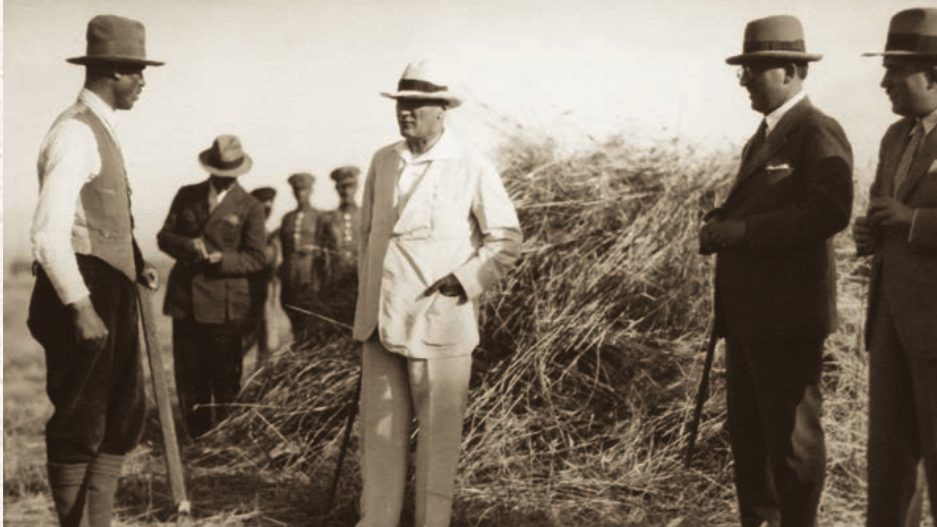
The Ottomans failed to achieve an agricultural revolution and so never reached an industrial one. The Republic set out to put agriculture, too, on a technical footing from scratch.
Key Achievements
- Atatürk Forest Farm (AOÇ). Founded on 5 May 1925 as the Gazi Forest Farm on Atatürk's personal initiative, the enterprise served as a model farm demonstrating modern farming techniques and formed Ankara's green belt.
- Model farms in Yalova. In 1929 Atatürk bought the Millet Farm in Yalova (by tender, for 14,000 lira, roughly 7,000 dönüm) and the neighbouring Baltacı Farm, conceiving both as modern production farms like the Forest Farm. Millet Farm specialised in grain, olive growing, livestock and American-style poultry keeping, and a dairy plant was built there; the two farms were merged under the Baltacı name in 1931. The Yalova farms were donated to the Treasury free of charge in 1937. Millet Farm is today the Atatürk Horticultural Central Research Institute.
- Model farms in Silifke. The Tekir and Şövalye farms covered about 12,000 decares in total. Atatürk inspected the land in January 1925 and the Tekir Farm was bought at auction for 36,000 TL through his agent. Rice and cotton growing stood out; on 13 May 1926 Atatürk visited the farm and watched a harvest carried out with newly imported agricultural machinery. Atatürk was member number one of the Tekir Farm Agricultural Credit Cooperative founded in 1936.
- Transfer of Atatürk's farms to the Treasury (1937). According to studies based on a Republican Archives document, the Yalova, Silifke, Dörtyol, Tarsus and Ankara farms together came to about 154,729 dönüm. On 11 June 1937 Atatürk notified the Prime Ministry that he was transferring his farms to the Treasury, and the Tarsus and Silifke farms were handed to the State Agricultural Enterprises Institution in 1938.
- Abolition of the tithe (1925). The abolition of the tax in kind on farmers directly raised agricultural production capacity.
- Agricultural Institutes and the Higher Agricultural Institute. The Higher Agricultural Institute, founded in Ankara in 1933, was Türkiye's first modern agricultural university-level institution and forms the core of today's Ankara University Faculty of Agriculture. At the intermediate level, agricultural schools reorganised under the 1927 law aimed to train the technical staff of rural development.
- Agricultural mechanisation. The farming inherited from the Ottomans rested largely on animal power and traditional tools. The AOÇ and Atatürk's private farms became showcases for modern machinery; on 13 May 1926, for example, Atatürk watched a harvest in Silifke carried out with newly imported agricultural machines. Even so, the great majority of villagers remained dependent on animal power through the period, and large-scale mechanisation belongs to the post-Atatürk years. The era's real contribution was to build the infrastructure that showed machine farming was possible and trained technical staff.
- State farms. Karacabey Stud Farm, Ceylanpınar and other state enterprises were centres of seed-improvement and breeding programmes. Today's General Directorate of Agricultural Enterprises (TİGEM) was founded in 1984 and took over most of these farms.
- Karacabey Stud Farm (1926). The enterprise that grew out of the Ottoman imperial farms (Çiftlikat-ı Hümayun) was handed to the Ministry of Agriculture in 1926 and reorganised as the Karacabey Stud Farm. In 1932–1936, 141 purebred Arabian horses were brought from Lebanon, Syria and Iraq, starting Arabian horse breeding.
- Ceylanpınar Agricultural Enterprise. The enterprise is rooted in the Şanlıurfa Group Directorate of the Agricultural Combines, established by Law No. 3130 of 12 February 1937. It was a large-scale state farm for the dry conditions of south-eastern Anatolia; sources place the start of actual operations between 1937 and 1943.
- Agricultural Sales Cooperatives (1935). Law No. 2834 of November 1935 introduced a cooperative model that allowed farmers to reach markets without middlemen. In 1938 five hazelnut cooperatives founded Fiskobirlik.
- Grain Office (TMO, 1938). The state purchasing body, created to stabilise grain prices and give farmers a guaranteed buyer, still operates today.
1925
Tithe abolished
1927
Agricultural reform law
154,729
dönüm of farmland Atatürk transferred to the Treasury (1937)
Source: Grand National Assembly Law Gazette, Ankara Higher Agricultural Institute Law; Ankara University Faculty of Agriculture history; Journal of Atatürk Research Center, "Developments in Turkish Agriculture per Atatürk's Directives (1923–1938)"; DergiPark, "Atatürk's Farms and Their Transfer to the Treasury" (based on Republican Archives documents); TİGEM enterprise pages (Karacabey, Ceylanpınar); Ministry of Trade history of cooperatives (Law No. 2834)